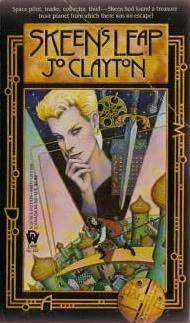
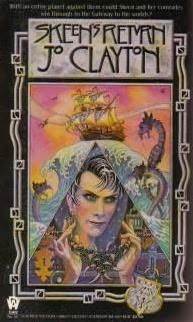
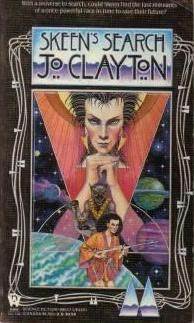
These three books.
I picked them up in my teens as they came out. And to be honest, a lot of what got me interested in them were the covers. These crazy hyper-designey things, featuring this handsome, androgynous-looking person looked like nothing else on the shelves.
What was inside turned out to be pretty nifty, at least to fifteen-year-old me: that androgyne turned out to be the titular Skeen, a star-trading woman who had been betrayed by her partner/lover, and ended up taking a one-way trip through a gate to a medieval fantasy world full of assorted aliens. She journeyed across that world, making various friends and enemies, and eventually made it back to her home reality, where her various fantasy-world friends got to bounce around between the stars. It was written in this somewhat affected but often appealing style. And Skeen was a character type I’m always a sucker for when done well: the silver-tongued scoundrel traveller, who cons and charms their way across a strange landscape. She was more than a little bit queer, as well. I mean, look at that butch lady on the covers.
There’s a moment somewhere in the middle of Skeen’s Return that taught me something important about telling stories. One chapter name suddenly goes on for four pages full of bold, all-caps text, during which Clayton stepped outside of her otherwise rigid attachment to the title character’s third-person viewpoint, to fill the reader in on some important backstory there was absolutely no way Skeen or her her friends could know. (Secret rituals of one of the alien races that populated this lost world, if you’re curious.)
And then later on, she does this again, and talks directly to the reader about the fact that she was sitting at a fork in the story: Skeen was lying near death, and Jo was having a lot of trouble deciding if she was going to pretty much completely recover, or die, or have a complicated recovery where she occasional lapsed into fever and madness, ‘kind of a Drunken Master thing’, to paraphrase Jo’s description of that path. She concluded this with the suggestion that the reader might, perhaps, pick one of those options, and keep that version running in their head, see how it diverged from the one Jo chose.
Not that I didn’t already love these books before I got to those bits, mind you. But something about casually stepping out from behind the curtain and addressing the raw problems of Telling A Story and Wrangling A Plot endeared these to me even more.
Like most of the other books I treasured, they were lost in Katrina.
Today, I made my occasional check to see if they’d been republished as e-books. They haven’t. Jo Clayton died in 1998, well before the age of e-books. And I sighed, and supposed I’d keep an eye out for them in used bookstores for several years, and eventually be able to re-read them and see if they were any good.
And then I remembered that I live in the age of the Internet, went on AbeBooks, and found used copies of them in stores in Indiana and Texas. And while I was there I also found copies of the first four books of Clayton’s earlier series, “The Diadem”, a space opera about a titular piece of headgear that contains the memories of multiple people. I had the eighth volume of that and found it kind of pleasantly befuddling.
These books will be arriving at various times over the next month. Will I enjoy them as an adult? Who knows.
Merry Christmas, future Peggy. I got you some lady-centric pulp sci-fi!