
Who’s a pretty girl? Who’s a good girl? Ball! Get the ball!
…I’ve been playing a lot of Bloodborne lately. Illustrator, 1:30.
Also finishing this made me miss the bus for tumbling class. Feh. Need to make more alarms I guess.
Who’s a pretty girl? Who’s a good girl? Ball! Get the ball!
…I’ve been playing a lot of Bloodborne lately. Illustrator, 1:30.
Also finishing this made me miss the bus for tumbling class. Feh. Need to make more alarms I guess.
 This is me playing with the painterly workflow I’m developing for Drowning City by using it on a future page of Rita. Now that I’m starting to use a lot of named Graphic Styles to organize my effects, I want to have that panel constantly open. It used to be in the same tab panel as the Brushes panel, but I was finding myself constantly toggling between them, so it gets more screen space.
You can pretty much tell how important a panel is to my workflow by how much screen real estate it’s give here, with the exception of the Stroke palette being more expanded than it really needs to.
This is my list of things I’d like to see in Illustrator. Everyone who uses it probably has one; this is mine.
Everything is ready to be cut and paste into Adobe’s feature request/bug report form; I keep these in an Evernote note that’s slowly expanding over the years as my usage of Illustrator changes.
*******Enhancement / FMR*********
*******Enhancement / FMR*********
*******Enhancement / FMR*********
One more thing about that faux-natural media piece and then I promise I’ll shut up about it and get back to making more art.
I’ve tried doing similar tricks in the past for many years. This is the first time I was able to do it and not have to constantly be thinking about how I’d do it. Oh sure, there were technical things to fiddle with, but I feel like I was working from a solid basis of some pre-defined graphic styles that I could quickly modify for the drawing at hand. I really did build a toolkit when I sat there doing Drowning City test stuff; most of my thoughts were entirely about the image and how it was developing, rather than “how can I make it look the way I want it to”. Every technical problem was something I’d solved already, and could grab my solution to without much work.
So yeah. Definitely a level up there.
If I am even moderately diligent about dropping new styles and whatnot into my toolkit as I create them for Drowning City, I should be able to do some pretty damn impressive things when I finish that project. Will the project after that be painterly? Hell if I know. But I bet it’ll be pretty easy to do it that way if I want to.
Hmm. So I keep looking at that genie “painting” I did yesterday, and I keep loving it. This is a place I’ve wanted to be with my art for years, but my love of Illustrator kept me away from. I could have been doing painterly cartoon stuff in Photoshop or Painter, but I couldn’t stand to lose all that lovely, lovely editability. Now Illustrator’s had a pass or two of speed optimization on these features, my computer’s an order of magnitude or two more powerful, and I can do things like “put the ‘roughen’ effect on 75% of the paths I draw in this image” and still have things run fast enough to be interactive at the very end of the drawing. Back when the features I’m leaning on were first introduced I tried doing painterly stuff and everything quickly ground to a halt.
Admittedly it can’t be hurting that I’ve also gotten a good handle on highly limited silhouettes and shading. But a lot of it is that my tools can finally manifest my vision.
I’ve been really pushing to figure this sort of look out for The Drowning City, and now I’m completely sure that I can make it look exactly like it needs to be. City is probably going to stay mostly greyscale but I’m pretty confident that I can speed up a lot of the process enough to keep it looking moody and painterly.
I wonder what kind of experiments I’ll be doing when I finish that book, a few years down the line. My skills and tools will have advanced another leap. Who knows?
But right now I should stop pondering the future so much and get back to work on Decrypting Rita. It’s astoundingly close to done; I just have a few mega-complicated pages staring me down, plus a couple dozen simple ones. None of them are gonna draw themselves.

Three bowls of Kosher Kush. Five hours. 100% Illustrator.
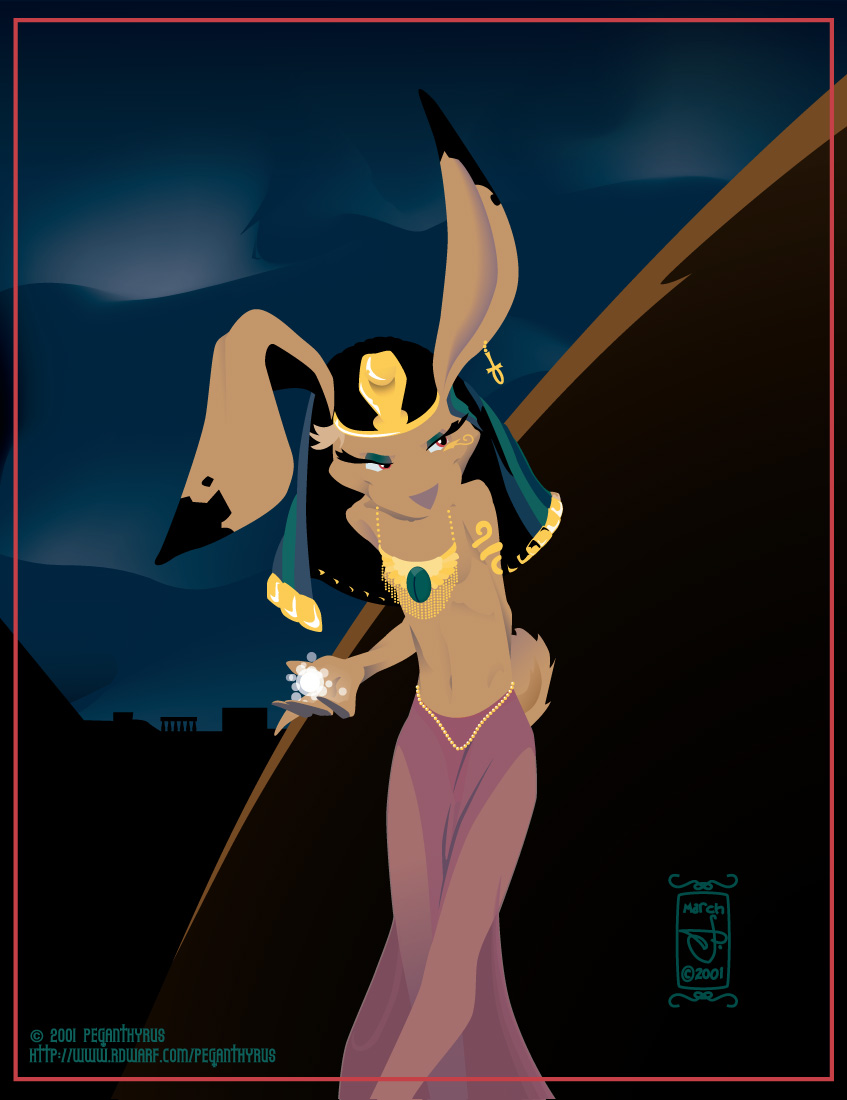
When I finished this, I suddenly remembered this old piece from March 2001. Apparently I did this over three days in Illustrator 9. Fourteen years has seen a lot of change in both my skills and Illustrator’s capabilities. (Well, I think I could have done all the tricks I used here in Illustrator 10 – but there is no way my computer would have been fast enough to handle them all.)
I also leaned on my past self: the jar on the left was plucked out of a recent page of Decrypting Rita, and the floor rug came from one of the Tarot cards. Both saw some modification but a lot of the basic work was already done.
One thing I’ve wanted for a while in Illustrator is the ability to randomly choose brushes. I finally wrote a script to make it happen.


So now you can draw a bunch of paths in, say, a “dying marker” brush, then decide it looks too obviously fake, make a few more (“dying marker 2/3/4…”), and randomize them.
Or you might make a “lovely fir tree” brush, draw a bunch of lines with it, then decide you want some variety and make a “lovely spruce tree” and “lovely larch tree” brush as well, and randomize them as well. Though if you added a “lovely sycamore tree” brush, the amount of name difference you’d have to allow for that one would probably end up selecting from almost every brush you had in the document. That’s what undo is for. And temporary brush renamings.
If this feels like a thing you could use then grab it here and put it in the scripts directory of your copy of Illustrator. Enjoy!
After ECCC, I came home and pretty much crashed for a couple of days. I spent like two days sitting in the living room in the dark playing Bloodborne; the third day was only half spent doing that, because Nick came over Tuesday night and we hung out some on Wednesday morning.
Today, I actually opened up the stuff I took to the con and put away all the merch I didn’t sell. I still have to put the other table stuff back in its usual place, but not today.
I also deposited the cash I got from the con – both profits and my boothmates paying their share. Putting $700 into an ATM is an odd experience.
Before that, I took a walk out through the park. It was really nice to be outside in the sun and not have to see very many people, and not have to worry about giving my pitch to a single one of them. Though I did end up giving my pitch today – I stopped at the comic shop to pick up a couple books they’d ordered for me, and mentioned I was paying cash for these two pricey hardbacks because I’d done well at ECCC, which lead to being asked what my comic was.
I did play some more Bloodborne. I made another run at the second boss (Father Gascoigne); I can get him into his final mode, and down to about 1/6 of his health, but I couldn’t quite seal the deal. If someone happens to rate one of my messages positively while I’m in the middle of my next attempt I’ll probably have him. And I might have him anyway, as said next attempt will be after a little grinding, which will probably result in both a level gain and a weapon upgrade for me. I’m quite sure whatever’s next will kick my ass in many ways.
I think a lot of the appeal of From’s games for me is the exploration. There is a part of my brain that is made very happy by things like “taking a long, winding path that leads to a place not too far from where I started, and finding a shortcut” or “seeing a place, wondering if I can get there, and finally piecing together enough of a mental map to get there”. The harsh difficulty of the game means you spend a lot of time going over the same places; the huge budget for modelling the world means it’s chock full of unique details and landmarks that make building a mental map a lot easier than most repetitive game worlds. I may never see the ending cinematic of this game or Dark Souls, let alone get 100% on either, but that’s not the point of these things for me at all. They’re just… a gorgeous theme park, with a lot of murder mixed in. And it makes my brain very happy to build a little mental model of these horrible labyrinths.
Or maybe the utter futility is part of the point for me. I’m not sure.
A tweet replying to that last post: “you may wish you were better at socializing but I am in envy of your concise pitching skills.”
Let me try to pass on some of those skills…
My pitches for my stuff are tight little nuggets of words. They start with a few hours sitting alone, contemplating the work at hand. I have one question in mind for a story: what's the emotional hook? When I find that, the next question is, how can I make it a surprise?
The naive way to pitch a story is to just start telling it. Let's say I was trying to pitch “Back To The Future”: “So there's this kid Marty, who likes to play guitars, and he has this crazy friend who's like a mad scientist, his name's Doc, and he makes all these wild inventions that are all totally useless until one day he takes a Delorean and turns it into a time machine, and…” By the time you get to what actually matters about the story the person you're telling it to has probably walked away. Or you've told the whole thing, spoilers and all, and why do they need to actually read it now? You gave it all away, right down to the uncomfortable moment where a suburban white kid co-opts the invention of rock and roll.
So we want to be more succinct. BTTF's central plot is that when Marty goes back to the 50s, his mother falls in love with him instead of his dorky father, and the resulting paradox begins to slowly erase his existence. He's got to play matchmaker, and then get back to his home time of the 80s. That's shorter but it's still a hell of a lot of words.
Someone standing on the other side of your table at a con is overwhelmed with information. The less you make them process, the better. Does it matter what the hero's name is? Nope. Take out the details that don't matter: “It's about a kid who goes back in time and falls in love with his mother. He's got to make her love his father instead before paradox wipes him out of existence.”
One short sentence with the simplest words possible that will reach out and grab your audience by the feels. Ideally there's a bit of a twist; “falls in love with his mother” isn't something that you would normally expect after “goes back in time”. That surprises the listener. You've got their attention; you've posed a problem, now you complicate it with the second sentence: he's got to play matchmaker, with the universe providing a harsh time limit.
So when I pitch Rita, I don't tell people about the details. I just say “It's about a robot lady dragged out of reality by her ex-boyfriend.” They laugh. Almost everyone has had That One Ex who drags then into their own special world of craziness, or knows someone who has; it's a situation they can sympathize with. And then the second sentence complicates her problem, and raises the stakes: “She's got to pull herself together across four parallel worlds before a hive-mind can take over the planet.” A bunch of complicated concepts that I really don't think people would be interested in without the emotional hook, but the first sentence has them already rooting for Rita, and starting to be willing to follow her through her particular odyssey.
It's kind of like reducing the entire story to a haiku. Meter is important; it has to flow off the tongue in an easy rhythm. And you need a surprising twist. This pitch was originally a little longer, but repeating it a few hundred times at every con for the past three years has smoothed all the sharp corners off and turned it into something that just falls out of my mouth automatically.
(I also have a shorter, snarkier version that I mostly use when I don't need to sell it to someone and want to express my delight that I'm making a living with something this absurd: “it's about a lesbian robot with PKD problems”. Which actually sold a book this weekend to someone who reflexively unpacks “PKD” into “Philip K Dick”. It's risky to do this IMHO, as it limits the appeal to people who do that. Same with saying “it's Mage, The Hero Discovered meets Rozencrantz & Guildenstern Are Dead” or whatever two existing works it can be defined in terms of – that's an accurate description of my long-gestating next comic, but utter gibberish to anyone who's not familiar with both stories.)
I don't unload the whole pitch at once. Someone stops at my table and starts looking at my stuff, they get told “I have prints, a Tarot deck, and a comic about a robot lady dragged out of reality by her ex-boyfriend.” If they gravitate to the deck, they start getting its pitch (which is a very different beast, as it's not a STORY I'm selling there). If they laugh at the ex-boyfriend line – especially if they say something like “oh I've had that happen!” then they get the second sentence of the Rita pitch, and an encouragement to flip through the book. If they pick it up, I tell them it's book 1 of 3, the last one will be on the Kickstarters around summer, and let them read. Eventually they either buy the book, move to the deck, or say “thanks” and walk away; the last gets told “take a flyer, you can read it all for free online.”
The deck's pitch is different. There's no emotion there, all I've found is a list of facts: “this is my Tarot deck, 99 cards, based on the Thoth and Golden Dawn decks, hidden images that appear when the light hits some cards just right. Comes with a full-color book, and is fully prepared to give you the finger.” I'll leave the bit about its heritage out sometimes based on how likely I think the viewer is to know what that means; if they stick around and dig through it I'll tell them that eventually. If they go “Ooh! A Tarot deck!” and make a beeline from across the aisle, and I see some occult signifiers (jewelry, tattoos, etc) then they definitely get it.
Some people don't show a reaction to any of my pitches. That's fine. I don't hector them; I say something like “thanks for stopping by, have an awesome con!” and let them move on. My work is not for everyone and never will be, and I'm fine with that. I also don't try to drag in everyone who comes within shouting distance of my table; I try to draw in people whose gaze lingers on my work, and if they slow to a stop they get the beginning of the pitches. I've seen people do well with more aggressive huckstering but I'm really not comfortable with it; it tends to push away the people who aren't interested, and away from your neighbor as well. I'm never happy when I'm next to one of those folks.
Nobody standing on the other side of your table for the first time cares what the name of your main character is. Or how long the book is, or what genre it can be pigeonholed into. Telling them this is just more random trivia to bounce around in a brain already full of all the other sights and sounds of the con.
You've got about fifteen seconds to engage a random con-goer's emotional mirroring circuitry. Make them count. Once you've got that, then you can tell them a little about your crazy dystopia where everyone is given a color-coded jumpsuit at the age of 25 and sent out into an uncaring world of elves and orcs, or whatever particular sf/f bullshit you thought would be cool to write a story about.
Some scattered thoughts about ECCC.
Best cosplay: the guy as Scarlet Witch. Headpiece, cape, tights, and very very filled bikini bottom. Nothing else. I think I lost a sale by pausing in the middle of my pitch to whoop my approval at him. Did not care. Was so worth it.
Weirdest question: someone passing my table asked “do you have any Final Fantasy fan art?”. The idea of going to a con and looking for fan art of a specific franchise just feels so alien to me.
I wish I was better at socializing.